



 EchoAPI for VS Code

 EchoAPI for IntelliJ IDEA

 EchoAPl-Interceptor

 EchoAPl CLI
 EchoAPI Client
 API Design
 API Debug
 API Documentation
 Mock Server


Why Your API Strategy Matters More Than Ever in the AI Agent Era
AI Agents elevate the strategic importance of APIs by serving as intelligent orchestrators, while APIs remain the essential, governed infrastructure for reliable execution. In the Agent era, robust API design isn't obsolete—it's the foundation for scalable autonomy.

AI Agents are moving fast — from research demos to real-world deployments across engineering, operations, finance, and customer support.
But beneath the hype, a hard question keeps surfacing among experienced developers and system architects:
If AI Agents can operate systems directly through UIs, browsers, and OS-level actions — do APIs still matter?
At first glance, it feels like a fair question.
If an Agent can:
- Click buttons
- Read screens
- Fill out forms
- Complete workflows end-to-end
Then why bother with APIs at all?
This article argues something counterintuitive:
AI Agents don’t weaken the role of APIs.
They make APIs more important than ever.
In fact, as Agents mature, the architectural boundary between:
- Agents as decision-makers
- APIs as execution layers
becomes clearer, not blurrier.
We’ll unpack this from five angles:
concepts, system layering, engineering constraints, real-world data, and industry trends.
1. First Principles: APIs vs. AI Agents
Let’s start by separating two things that are often conflated.
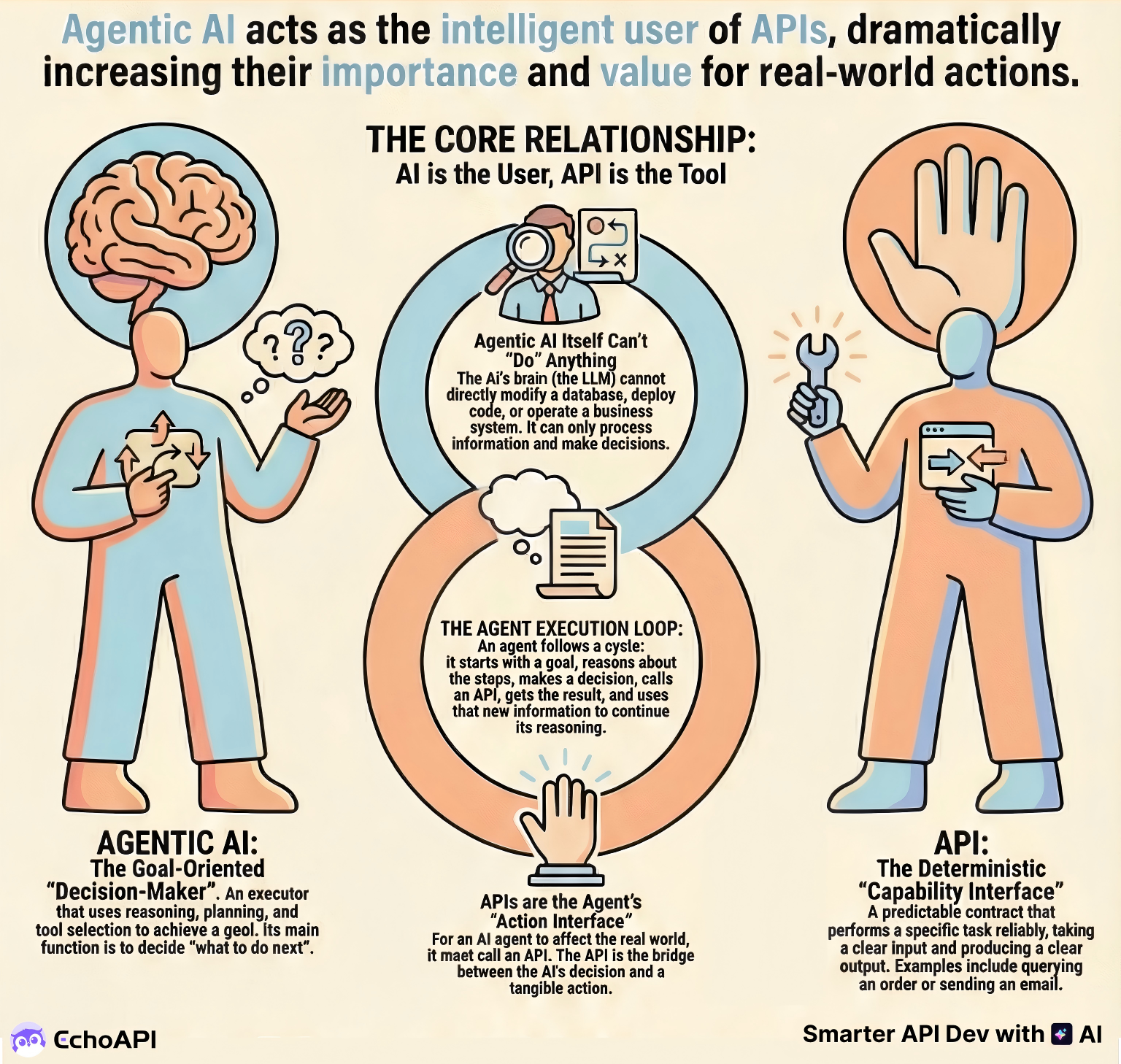
APIs: Stable, Governable Capability Contracts
An API isn’t a technology choice — it’s an engineering promise.
At its core, every API exists to guarantee three things:
- Standardized access to capabilities
- Deterministic input → output behavior
- Governance (auth, rate limits, auditing, versioning)
REST, GraphQL, gRPC — the protocol doesn’t matter. The idea does:
An API defines what a system can do.
That’s why:
- Microservices depend on APIs
- Cloud platforms are API-first
- Over 70% of enterprises design systems around APIs
APIs were never meant to be “smart.”
They’re meant to be predictable, composable, and trustworthy.
AI Agents: Goal-Driven Decision Systems
Agents play a completely different role.
A modern AI Agent typically:
- Observes context and state
- Reasons and plans
- Selects tools
- Executes actions
- Adjusts based on feedback
In other words:
Agents don’t provide capabilities — they decide when and how to use them.
This leads to a key insight:
Agents are natural API consumers, not API replacements.
2. System Architecture: Where Agents and APIs Actually Sit
The fastest way to clarify this debate is to look at system layers.
A Typical Agent-Centric Architecture
┌─────────────────────────┐
│        User / Goal       │
└───────────-─────────────┘
            │
┌───────────▼─────────────┐
│        AI Agent          │  ← reasoning & orchestration
│  (LLM + Planner + Memory)│
└───────────-─────────────┘
            │
┌───────────▼─────────────┐
│          APIs            │  ← capability boundaries
│  DB / Payment / Auth     │
│  Search / Notification   │
└───────────-─────────────┘
            │
┌───────────▼─────────────┐
│   Infrastructure & Data  │
└─────────────────────────┘
Key takeaways:
- Agents live in the decision layer
- APIs live in the execution layer
- They’re complementary, not competitive
Without APIs, an Agent loses most of its real-world power.
What About UI Automation?
A common counterargument:
“Why not let Agents just use the UI directly?”
This has been tested repeatedly and the results are consistent.
APIs outperform UI automation in almost every serious system:
- Structured interaction: APIs are explicit; UIs are ambiguous
- Reliability: APIs don’t break when layouts change
- Maintenance cost: UI tweaks break automations; APIs evolve with versioning
- Governance: UIs lack auditing, permissions, and rate control
Put simply:
UIs are built for humans. APIs are built for systems.
Whenever an API exists, a rational Agent will prefer it.
3. Engineering Reality: Constraints Agents Can’t Ignore
Theory aside, production systems impose hard constraints.
Security, Compliance, and Accountability
Any meaningful operation requires:
- Authentication
- Authorization (RBAC / ABAC)
- Audit logs
- Compliance (SOC2, GDPR, ISO)
These controls live — almost exclusively — at the API layer.
Without APIs:
- Who did what?
- When?
- Under which permissions?
- How do you roll it back?
Agents don’t replace governance. APIs enforce it.
Access to Real Data
Critical systems don’t expose raw access:
- Databases
- Payments
- Identity systems
They expose controlled APIs.
This isn’t just technical — it’s organizational risk management.
Agents reach the real world through APIs.
4. Reality Check: What the Market Is Actually Doing
If Agents were replacing APIs, we’d see:
- Shrinking API markets
- Falling API usage
- Declining API tooling
We see the opposite.
APIs Are Growing
Industry forecasts show:
- API management market: ~$4B (2025)
- Projected ~$50B by 2030
- ~18–19% CAGR
That’s not a declining technology.
Enterprises Are More API-Dependent Than Ever
Surveys consistently show:
- Companies integrate 26–50 APIs on average
- 70%+ adopt API-first architectures
- SaaS and cloud platforms are APIs
Agents aren’t reducing API usage — they’re amplifying it.
API Governance Is Expanding
API gateways, security, and observability tools continue to grow for one reason:
Systems rely on APIs more, not less — especially when Agents are involved.
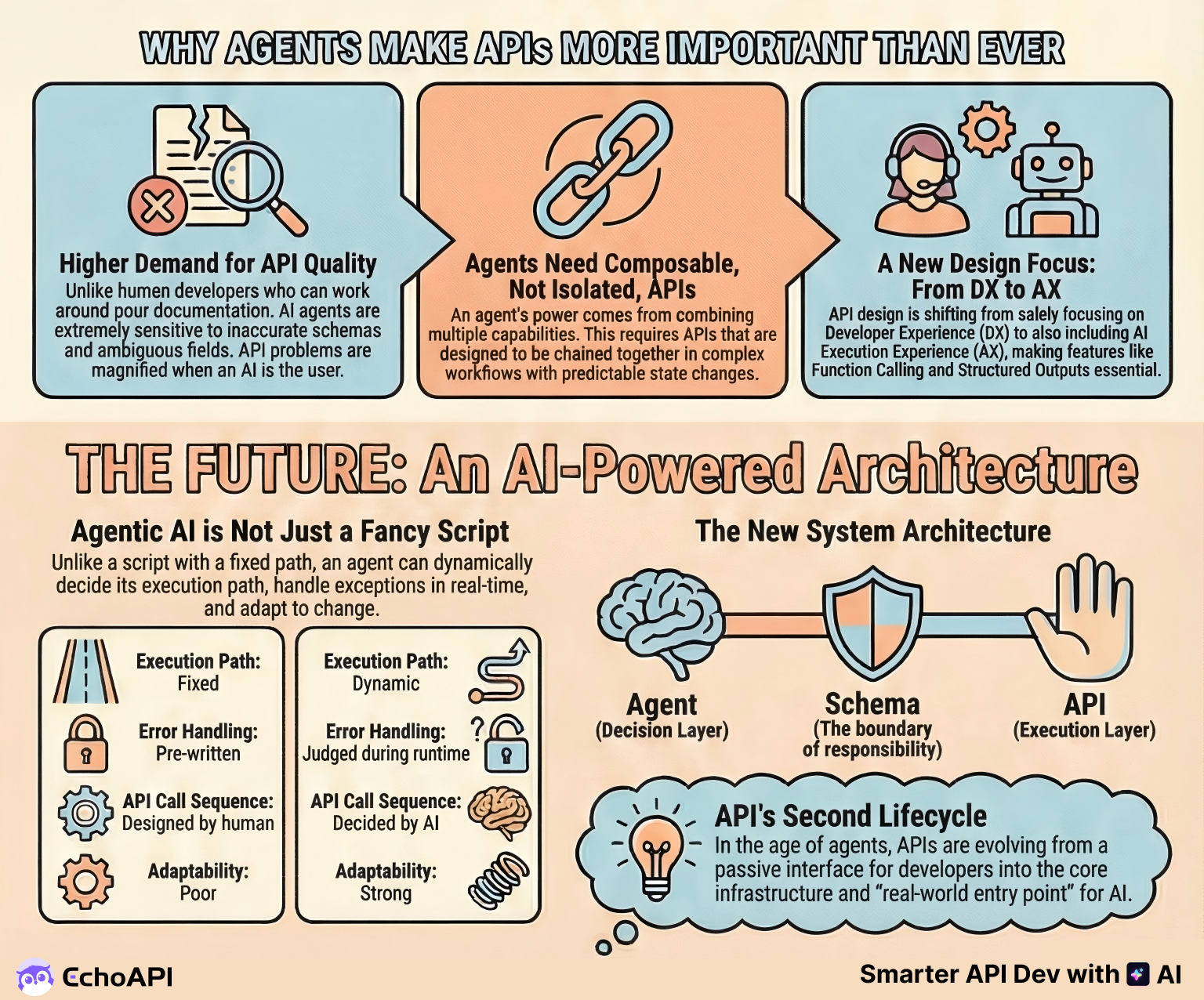
5. The Real Shift: How APIs Are Evolving for Agents
This is where things get interesting.
From Human-Friendly APIs to Agent-Friendly APIs
Traditional APIs assumed human developers.
That assumption is changing.
Modern API design is shifting toward:
- Machine-readable schemas
- Explicit semantics
- Clear failure modes
- Declared side effects
- Cost, rate, and risk metadata
APIs aren’t fading — they’re adapting.
Agents as the Orchestration Layer
Agents shine at one thing:
Turning multiple API calls into goal-oriented workflows.
Example flow:
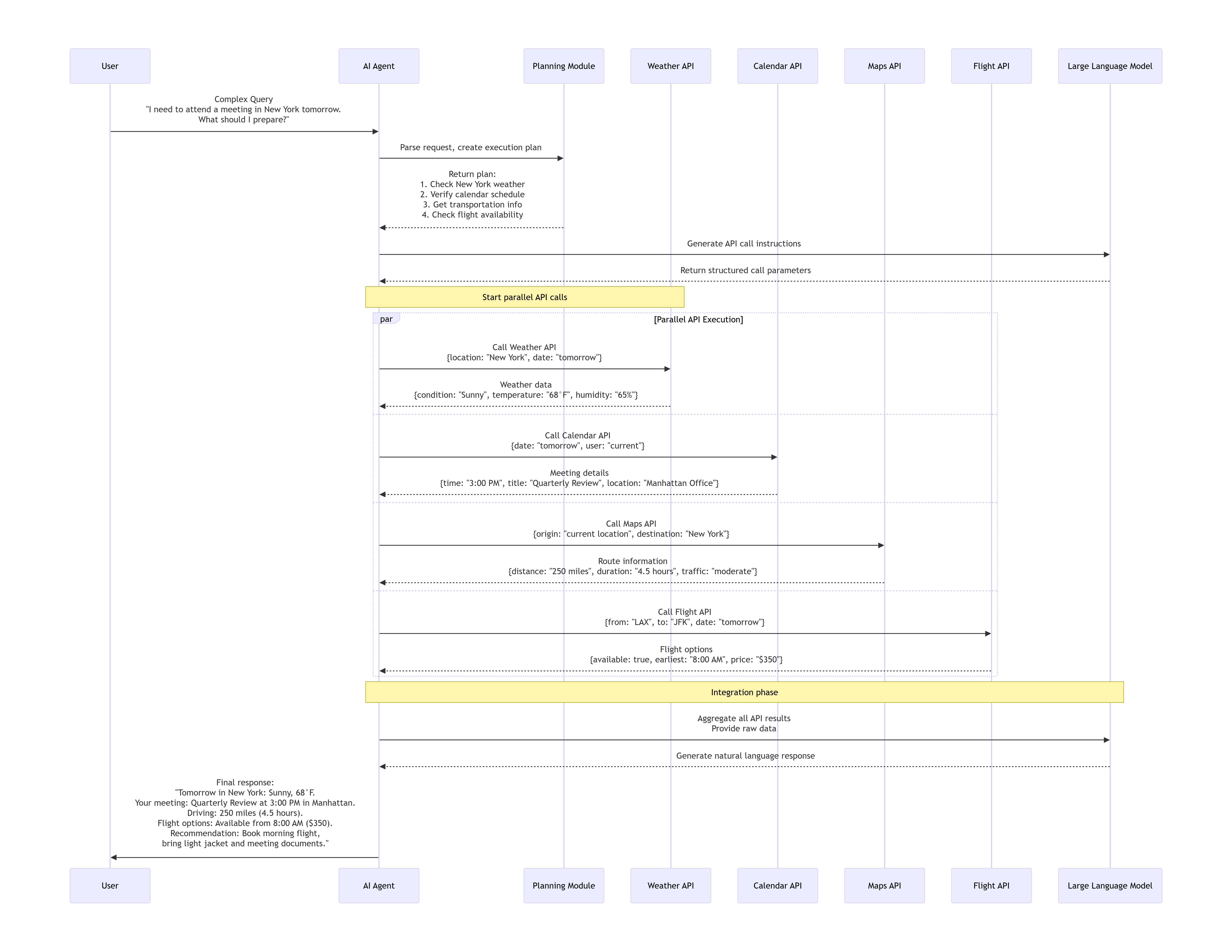
Participants:
- User defines intent
- Agent plans the workflow
- Planner decomposes tasks
- APIs execute actions
- LLM handles language & reasoning
This isn’t API replacement — it’s API leverage.
New Protocols Reinforce This Direction
Protocols like Model Context Protocol (MCP) exist for one reason:
To let Agents call APIs more safely and more consistently.
They don’t bypass APIs.
They formalize them.
Conclusion: Agents Change How APIs Are Used — Not Whether They’re Needed
AI Agents don’t make APIs obsolete.
They make weak APIs obvious.
- APIs define what can be done — safely and reliably
- Agents decide when and how to do it
The real competitive edge in the Agent era isn’t “having AI.”
It’s answering this question:
Are your APIs clear, stable, governable, and ready to be used at scale by autonomous Agents?
We’re at an architectural inflection point.
Agents are redefining API consumption, not eliminating APIs themselves.
Teams that invest in Agent-ready API infrastructure — clear schemas, strong governance, predictable behavior — will move faster, safer, and further.
Instead of asking:
“Will Agents replace APIs?”
The better question is:
“Are our APIs good enough for Agents?”
That’s where the real advantage will be built.
